Tuesday, March 31, 2009

SocialWeb at Web 2.0 Expo

What has been happening with Data Portability on the Social Web. ie. OpenID, OAuth, etc.

The workshop is being run by @chrismessina, @daveman692 and @jsmarr

I will twitter comments from this session using the tag #w2e_sw

If you want to build new and innovative services you don't want to frustrate your users by asking for a bunch of account related data. If the data is out there go and get it. Don't Re-Key!

You need standards to enable mashups. Alternatively, you need consistent formats.

If standards exist - use them!

http://www.oxyweb.co.uk/blog produced a world map of popular social networks. This struck me as a great parallel to the HealthCare world with incompatible/competing health care players.

Functional sites, like Friendfeed, Twitter, last.fm and Dopplr represent specialist services. They have the opportunity to create combined value but they need a social graph to create this.

Facebook solved this for many, as long as developers were prepared to live inside facebook.

Activity streams are an emerging standard. No logo yet.

XMPP is not that popular yet, although it is one of the pipes that Twitter implemented and search.twitter.com leveraged.

Partuza is an Open Social - social Network site that uses Apache Shindig.

Pinax is a platform for rapidly developing websites using social tools such as IM, chat,

The emerging theme is "Connect"

Facebook Connect, OpenSocial Connect.

New building blocks:

  • Who you are
  • Who you know
  • What's going on

These are aspects of the social ecosystem. These create the virtual circle of sharing/knowing.

The anatomy of "Connect":

  • Profile (id, accounts profiles)
  • Relationships (friends, followers)
  • Content
  • Activity
  • Goal (search and discovery)

Most sites are building on the Open Stack:

  • MySpace
  • Yahoo
  • Google
  • Plaxo
  • Microsoft

Supporting:

  • OpenID
  • XRDS-Simple
  • OAuth
  • PortableContacts
  • OpenSocial

Facebook is different but is matching these standards.

Why do this?:

- Why do people have to:

  • Create a new account on every service
  • Re-create their profile
  • Give away their password to every site that asks
  • Re-discover their friends
  • re-friend their friends
  • Learn new ways to share and communicate

Why do developers have to?:

  • Deal with forgotten passwords
  • create another profile form
  • Support every new service API that emerges
  • Force members to invite everyone they know
  • Implement and unsafe method to import contacts
  • Create widgets for incompatible social networks
  • Manually interpret feeds for activity streams

Industry trends:

  • User control of data
  • User centric web services
  • Locatin based services
  • Real time content delivery ubiquitous connectivity
  • Interoperable app platforms
  • content aggregation and syndication
  • increasing quantities of data to work with
  • democratization of digital media creation tools

How do customers benefit:

MySpace has built login with OpenID and OAuth to compete with Facebook Connect.

OpenID popup extension is being developed to simplify the user interface, ala facebook connect.

The emerging issue is that once an item has been made "public" on a social network it can't be withdrawn. If you withdraw an item it may still exist in other places that were connected to the original publishing location.

Demos:

Now for the technical stuff:

OpenID Demo:

Mapquest (owned by AOL). You can sign in to mapquest with OpenID.

In 2009 there are over 30,000 sites that let you login with OpenID (Relying sites). Growth from 20,000 in August 2008 and 10,000 in Jan 2008. (source: http://blog.janrain.com)

Implementing OpenID as a relying party (ie. accept OpenID)

Internally you need to map one or more openIDs to an internal account.

The OpenID User experience

Directed Identity is emerging as one solution to avoid need for users to know URLs.

At least there aren't too many major providers so the button option is still feasible.

Once people have become known to a site it is possible to tailor re-sign in based upon where a user has come from. eg. If they arrive from Gmail then assume a gmail account.

Personal Discovery standard is emerging, driven by EU demands.

The browser knows who you are so this may be a way to simplify login. This moves away from web sites trying to guess which accounts you use.

The Popup extension is emerging as a technique. The challenge is to avoid spoofing. People don't look at the URL bar.

Remember - you can use email address as an indicator of which OpenId providers to support.

Different sites have different account preferences. This leads to sites supporting multiple standards. eg. OpenID + facebook. At least supporting OpenId means you automatically support Yahoo, AOL, Google, MySpace and other popular sites.

Microformats are also important.

Microformats enable webpages to be an API.

Semantic information can be embedded in a page. Some of the oldest standards are hCard (vCard in HTML)

Use CSS classes to markup and style the data. Very simple way to markup information in existing web pages.

This is ideal for database driven sites because you can edit one output web page and apply a microformat to every database record that is displayed through that web page.

Twitter supports hCard and includes the rel=me setting. If you want your blog to be the top search result on your name in Google then add this value to your blog. Simply add rel="me" to a relevant link on your blog.

Discovery

The more you publish the more you need a way to identify what you are publishing as yours. Our desktop is moving out in to the cloud.

Identity enables discovery. XRDS-Simple "the name is more complex than the concept"

XRDS - defines services.

eg. OpenID, PortableContacts

eg. OpenID points to one service. PortableContacts points to Plaxo.

WordPress OpenID plugin supports creating XRDS file.

XRDS-Simple can be used for a personal discovery or for sites to publish their service endpoints

LRDD - Link-based Resource Descriptor Discovery (emerging work)

Authorization

Authorization is important so you don't have to make data public to make it portable.

Will OAuth work in a mobile mode? Yes!

iPhone example is FlightTrack Pro works with Tripit. The iPhone app uses OAuth and Safari to authorize the app on Tripit.com.

OAuth is a protocol for developing password-less APIs.

Plaxo was recently bought by Comcast. Comcast saw a 92% success rate with login using OpenID in collaboration with Google.

The Plaxo-Google connection uses a hybrid. They do the OpenID dance and also handle the OAuth token acquisition at the same time. They also collect and notify user on the basic information that will be used. eg. name and email address.

The Comcast-Google test worked so well that the business folks at Comcast wouldn't let them turn the experiment off!

OAuth can be used asynchronously to allow one user to give permission to someone else to gain access to their information. eg. Dave allows Chris to see his phone number in his contact record.

Relationships and Contacts

Rather than have to support writing to address book APIs for each major service they instead implement a standard protocol. That is PortableContacts. This builds on OAuth and vCard standards.

GMail now supports Portable Contacts. ie. No Google specific code is required to use information from the Google Addressbook.

OpenSocial REST People Protocol is now PortableContact compatible.

vCardDav compatibility is coming with IETF.

Linking Accounts

The XFN Microformat is being used to link accounts and services.

Add a Rel=Me link to connect pages on services..

You can also use Rel=Contact to identify friends.

Google's Social Graph API does this in a simple form. A demo is available.

Activity Streams

Activity Streams are in the realm of "LifeStreaming"

Friendfeed support approximately 59 services. Each was hand coded by Friendfeed.

Activity Streams is about creating a protocol that can be leveraged across sites.

Social Discovery. eg. Plaxo Pulse, LinkedIn network updates, Facebook status updates.

Messaging: Twitter, Yammer, Eventbox (desktop app)

Brand/Personal Monitoring: GetSatisfaction's Overheard searching Twitter.

Primitives: Active, Verb, Object

Actor, Verb Object (context)

Build on Standards

Use ATOM for lists. (aka feeds)

Activity Stream is using a derivation of ATOM to share streams.

Activity Streams is targeted to go in to OpenSocial.

Check out http://activitystrea.ms for the latest info.

Gadgets and OpenSocial

Allow applications to be added tomultiple sites. Write a gadget once and allow in to run on multiple sites. Over 700M users acorss multiple sites support OpenSocial from Myspace to Plaxo to Ning oor Orkut etc.

Shindig is an Apache incubator project for gadgets in OpenSocial.

You can also build OpenSocial apps in the Google AppEngine.

This standard simplifies Engineering integratin and allows developers to focus on PRODUCT integration - ie. How to fit in to the target environment. eg. Ning is different from MySpace.

Next Steps - Homework:

1. Markup existing Data

2. Stop leaking passwords

3. Support OpenID and OAuth

These tools are mature enough to enable simple integration across sites and business partners.

Check out theSocialWeb.tv for the latest news in the space.

Web 2.0 Expo kicks off with a HealthCampSf sub-agenda

This week I am at the Web 2.0 Expo event in San Francisco. This is my third year at this event and it is one of the leading conferences that is addressing this Internet world we call "Web 2.0"

While I am here I am also leading a Health Care Birds of a Feather session on Wednesday Evening at the nearby Marriott Hotel. The topic of the session will be "HealthCamp - A call to action in the transformation of Health Care". If you are in the area come along and join in the HealthCamp discussion.

One of the best parts of the Web 2.0 Expo is the Un-conference track: Web2Open. I am planning to put a couple of HealthCamp sessions on the schedule. If you are interested in Health Care please come along and join in. Use the code: websf09opn when you register to get access to the Web2Open track.

Now I am off to the first workshop session - Nancy Duarte: Tools for Visual Storytelling

Notes from Nancy's session

The Visual communicators will win.

There is no course for Visual Business Communication

A presentation pulls everything off the slide except the single idea for the audience.

The basic default for presentation in Powerpoint is a document with title and bullets.

Focus on the audience.

The first exercise. We are using a meebo chatroom to brainstorm.

Every presentation should have a S.T.A.R - Something They'll Always Remember

Stories have meaning. Sharing the story involves others with that meaning.

Six Tips for Remote Presenting:

1. During preparation show the flow of the presentation

2. Make slides be you. Be Open. One idea per slide. No font smaller than 32 point

3. Create a "Real" Presentation Environment (pictures of an audience). Stand up.

4. Lure and Re-Lure using bite-size pieces. "Look at how this slide illustrates my point" Have Fun! Remove Distractions

5. Use good Netiquette. Remove dangly/jangly stuff. Kill apps that make noise. Start on time. Avoid non-content filled words. no. uh.huh. no sidebar comments.

6. Send slides ahead of time.

Diagrams:

Abstract concepts v Realistic concepts

Abstract:-

Flow: Linear / Circular / Convergent-Divergent / Multi-Directional

Structure: Layers / Trees / Matrices

Cluster: Overlapping / Closure / Enclosed / Linked

Radiate: With a Core / Without a core / From a Point

Realistic:-

Display Data: Comparison / Trend / Distribution

Pictoral: Process / Reveal / Direction / Location / Influence

Always think through the structure.

Shifting from Words to Pictures

Partnership - Think Salt and Pepper, Bread and Butter, Milk and Cookies

Everything in nature has a structure.

The web and magazines use grids for structure. Yet we never do this in PowerPoint.

Tips:

1. Think away from your computer

2. Think through the structure of diagram before adding images.

5 Rules for Data:

1. Tell the Truth

2. Get to the point

3. Pick the right tool for the job

4. Highlight what's important

5. Keep it simple

Bar Charts don't need depth. It creates confusion.

Presented data is different from statistical data.

Presentations are a glance media - the 3 second rule. We can't process quickly enough.

Chart backgrounds are context. use light grey v dark grey (not black). Use neutral colors except the areas of emphasis.

Don't force the audience to work too hard.

Reduce non-data information. Eliminate unnecessary information. De-emphasize non-essential information.

Highlight the information to be emphasized.

Quantitative Relationships: Nominal Comparison / Time series / Ranking / Part-to-Whole / Deviation / Distribution / Correlation

Transparency of Data is important but meaning comes from being vulnerable and telling a story that connects you to the audience.

Sunday, March 29, 2009

HealthCampPhiladelphia (#HCPHL) - that's a wrap!

Yesterday saw the first HealthCampPhiladelphia take place. This is the largest HealthCamp event held so far and took place thanks to a great local organizing team led by Mary Ann Geier.

The others on the team included: Kelani, Gloria Bell, Mark Magliocco, Whitney Hoffman, Phil Baumann Melissa Thiessen (who organized the Jefferson University facility) and Maumi Chatterton . A special thanks also has to go to Carl Lusby who provided and supported his fabulous Ruby on Rails based scheduling app. If you are planning to run a barcamp event you need to talk to Carl about his mobile schedule app.

People travelled in to the event from as far afield as Maryland, DC, Connecticut and New York. The event's hashtag (#HCPHL) hit the top twitter trending topics more than once during the day. People were following the Twitter feed from across the UK and Europe.

The level of interest and active participation in the event only serves to underline the importance of addressing and encouraging change in Health Care. The idea behind HealthCamp is that the healthcare system is broken and we need to rebuild it, together, on a participatory model that leverages the best the social networking, open standards and Internet and mobile technologies have to offer.

I was encouraged by the discussions that took place at the end of HealthCampPhiladelphia. Requests were made for a HealthCampNewYork and for a follow-up event in Philadelphia that will involve more medical practitioners. Those from the medical community that were at this event seemed committed to spreading the word to their colleagues.

Health Care is a complex beast. Making change is not simple. But change is something we have to do. Because it is such a complex environment it is imperative that we look for ideas, inspiration and solutions by casting a wide net. This is the purpose of HealthCamp. It is a venue for conversation that can spark solutions. It is my desire to see all parts of the health care industry represented, together with entrepreneurs, developers and consumers and patients. This is not a place to come and just complain about the current situation. Come and make suggestions on how to make it better. It is out of these discussions between Doctors, nurses, developers and consumers that new and innovative solutions can come.

If you are interested in getting involved in the HealthCamp movement then please drop me a note. The best way to reach me is either by commenting on this blog or sending me a message on twitter (@ekivemark). We have an evolving HealthCamp wiki on Wetpaint that you are welcome to join. (http://healthcamp.wetpaint.com)

If you are in San Francisco this week come to the Web2Open Un-conference at the Web 2.0 Expo and get involved with an impromptu HealthCampSf. There is also a Birds of a Feather HealthCamp session as part of the event on Wednesday April 1st at 7pm. You can get a free ticket to the Web 2Open sessions by checking out the special discount code on the Web2Open page.

On Tuesday April 21st in Boston HealthCampBoston and SocialPharmerBoston are hosting a joint Camp event. It takes place at Microsoft's R&D facility in Cambridge, MA. If you were planning to attend Health 2.0 then come a day earlier and get involved in HealthCampBoston. Tickets for this event go on sale this week. Check out http://healthcampboston.eventbrite.com. I am looking forward to the event because it will be an opportunity to extend the HealthCamp message in to the Pharma sector at a very opportune time. The Pharma sector is actively experimenting with Social Media and trying to understand how Social Networks will shape their market and community outreach plans. From a HealthCare perspective any plans to transform HealthCare have to involve Pharma.   

Finally, if you are interested in getting involved in HealthCampMd 2009 please let me know. If you have a base in New York and can help provide a location for HealthCampNY please get in touch.

In signing off: To everyone who came to HealthCampPhiladelphia. The event was a great success because of your active participation. Thank You!

Saturday, March 28, 2009

HealthCampPhiladelphia (#HCPHL) is live

This morning the volunteers are amassing and participants are starting to arrive. Follow the action here, via CoverItLive or on search.twitter.com using the hashtag #HCPHL


This is the HealthCampPhiladelphia CoverItLive RSS Feed:http://rss.coveritlive.com/rss.php?altcast_code=8d547fcfae


Friday, March 27, 2009

HealthCamps in Philadelphia, San Francisco and Boston

It has been a busy week. In a little over 24 hours I will be attending HealthCampPhila. All the tickets for the event on Saturday 28th March have been sold. The local organizers have done a fantastic job to prepare for this event. I will be doing my best to Twitter at the event. I will set up another Coveritlive widget on this blog.

To get a flavor of the HealthCampPhiladelphia event check out this introductory video:

After HealthCampPhila I am heading to San Francisco for Web 2.0 Expo. I am hosting a Birds of a Feather HealthCampSf Session on Wednesday April 1st in the evening (7pm). If you are at the Web 2.0 Expo and are interested in the transformation of Health Care then come along to this event. I will also be taking part in the Web2Open Un-conference track at Web 2.0 Expo and intend to lead one or more HealthCampSf sessions there. I am also looking forward to catching Jay Parkinson, MD of Hello Health who is hosting an Un-conference session on "Health 2.0 - New Delivery Models". That takes place on Wednesday April 1st at 9:40am.

This week also saw the plans for HealthCampBoston drop in to place. This will be a joint event with Social-Pharma. The event takes place on Tuesday April 21st at the Microsoft New England Research and Development Campus in Cambridge, MA. This is the day before Health 2.0 that takes place in Boston.

To get tickets for HealthCampBoston goto eventbrite (http://HealthCampBoston.eventbrite.com). My sincere thanks go to @cerro, @healthblawg and @shwen for helping to get the Boston event off the ground.

In other HealthCamp News I heard that HealthCampSeattle is entering the planning stage and the organizing team (thanks to @2healthguru) is making progress on HealthCampSanDiego for some time in June 2009. I also need to check up on HealthCampNash. The date for the Nashville event looks like Saturday May 30th.

When I get a chance to catch my breath I need to start planning for HealthCampMd to take place in Baltimore in May. Are there any Marylanders interested in helping to organize this event? If so please get in touch. Drop me a message on Twitter (@ekivemark).

If you are in Philadelphia on Saturday or San Francisco next week come and say hello!

Wednesday, March 25, 2009

Enterprise Mashups - A definition

A couple of weeks ago Luis Derechin, CEO of JackBe, was interviewed on FoxNews. He was asked to define what an Enterprise Mashup is.


After the event JackBe ran a little competition for their developer community where they asked for a better definition of an enterprise mashup. The winner being awarded the honorary title of "Mashup CEO".

I submitted the following definition:
"An enterprise mashup is a real-time application that can be built by users or developers using data pulled from public or internal sources that creates new insights and understanding as a result of combining previously unconnected information in new ways.

The Enterprise Mashup Platform enables Just-in-Time development of solutions that reflect the real world reality that we need to use information from a wide variety of source applications in ways that were never dreamt of when the applications were originally designed and implemented.

The Enterprise Mashup platform differs from Consumer Mashup Services in recognizing and working within the security and audit requirements of an organization while enabling public and internal data to be brought together to create valuable and actionable information."

It appears that this definition was one of 6 selected in week 1.

Here is a video version that I uploaded to Screencast:

Thursday, March 19, 2009

HealthCampPhila is nearly here!

There is just over a week until HealthCampPhila kicks off on Saturday 28th March at Jefferson University. There may be a few tickets and sponsor slots left - check on eventbrite for the latest status (http://healthcampphila.eventbrite.com).

The event is primed to generate some fascinating discussion. If you are planning on attending the event then do come up and say hi!

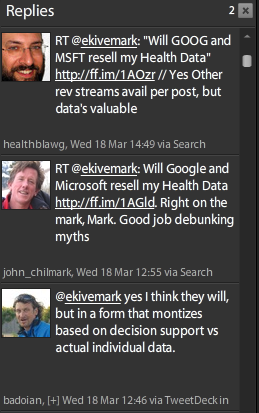
On a separate note I wanted to follow up on my last post where I addressed the issue "Will Google and Microsoft resell my health data?" This question caused some re-tweeting and commenting on Twitter.

Tweeted comments about PHR data

I want to thank David Harlow (@Healthblawg) for creating a "connect the dots" moment for me. His comment about health data being valuable took me back to posts I wrote over a year ago for AOL when I was considering OpenID, AIM, identity and portable reputation. The investment that we have made in instant messenger screen names that we have held for years represents a powerful element in building identity. However, that identity is virtual. The PHR is different.

The Ahah! moment for me was the realization that as Microsoft and Google enable us to store our health data they are in fact creating an incredibly valuable tool for trusted and credentialed identity.

Think about this. Facebook is creating a trusted identity system based upon our use of real names and the verification that a circle of friends know us. The online Personal Health Record (PHR) is subtly different from the trusted Facebook identity. The online PHR is being built with data linkages in mind. It is a resource that is, or will be, incredibly rich in transaction and linkage data based upon real world encounters. The PHR becomes like an online fingerprint.

What Google and Microsoft are building is a mechanism that they could leverage to validate that the person behind a LiveId or google health account is really the person that they say they are. This is not a binary true or false value, it will instead be a variable level of certainty - A level that is based on the depth of real world encounter information such as clinical history, claims information, family history and other data collected in the record and the number of authenticated touch points that link to the PHR.

Google and Microsoft could get incredible value from this information. Not from selling the information. Not from analyzing the information to push more ads. No, the value could come from the fact that this pool of data could become more valuable than our credit histories. The difference between the PHR and our credit history is that we, as consumers, have control over our PHR but only visibility in to our credit history.

Without releasing any contextual data about us Google and Microsoft could create the equivalent of a credit score that represents the level confidence in the authenticity of an account.

With the PHR sitting firmly at the intersection of the real and electronic world it is no wonder that these two giants are locked in a land grab battle for consumer mindshare.

Wednesday, March 18, 2009

Will Google and Microsoft resell my Health Data

A question that seems to be bubbling around on the Internet about the Personal Health Record platforms from Microsoft and Google is

"Will Microsoft or Google sell my Personal Health Data?"

The reality is that Microsoft or Google do not need to sell our personal health data. Microsoft's push in to health is a way to push the Windows monopoly. Adopting HealthVault is going to lead to hospitals, practices and software developers acquiring servers and software to connect in to the ecosystem that is being constructed. As devices become inter-connected we will probably also see the "Works with HealthVault" licensing program take off.

From the Google perspective a revenue model may be different. We will certainly see some linkage back to their Search and AdWords platforms. Google Health helps to keep eyeballs focused towards Google properties. On the developer side Google could easily provide open access to health data through APIs that preserve the consumer-managed privacy controls and generate revenue by throttling the API. They might for example allow developers to access thousands of API calls per day, week or month but require licensing to tap in to higher volume feeds. It is the developers that then create the business models to profit from these data feeds, but all the while the consumer continues to control what data they are releasing to which applications and services.

Sunday, March 15, 2009

HealthCamp Season

A couple of weeks ago HealthCampDc was held at the CareFirst offices in Washington DC. A great crowd turned up and actively participated throughout the day. This event is kicking off a great season of HealthCamps. People all over the world are starting up HealthCamps. Watch out for them in Canada, the UK and across the USA.

New HealthCamps are in the planning phase for HealthCampSanDiego and HealthCampToronto.

The biggest HealthCamp event is taking place in Philadelphia. HealthCampPhila happens on Saturday March 28th. There are a few sponsor and participant places left but the event is headed for a sell-out with over 100 people planning to attend. You can check for tickets on eventbrite at http://healthcampphila.eventbrite.com.

The following week I am hoping to attend the Web 2.0 Expo in San Francisco. If I make it out there I plan to run some HealthCampSF sessions as part of the event. If you are attending the event then watch out for those events in the Web2Open Un-Conference and Birds of a Feather tracks.

Later on in April, I also hope to make it to Boston for the Health 2.0 conference. Planning is underway to run a HealthCamp Workshop on April 21st. If you are planning to get to Health 2.0 then come a day early and join in with HealthCampBoston! Planning for this event beings in earnest tomorrow. A conference call for people interested in organizing this event takes place on Monday March 16th at 4pm EST. If you are interested in joining in the call then please drop me a message on Twitter (@ekivemark) with the hashtag #HCBos09.

HealthCampSf will be somewhat an ad-hoc event but if you are planning to attend then drop me a message on twitter (@ekivemark) with the hashtag #HCSF09.