Monday, November 30, 2009

#SecretDCHC - just a few hours away

Tuesday 1st December sees #SecretDCHealthCamp happen in Washington DC. This is not your usual HealthCamp.The event is a planning day.

I have two objectives in mind for this camp, but as ever, the outcome will be driven by the participants.

1. Health 2.0 Goes to Washington

Put the planning and organization in to effect to create a June 2010 event that brings HealthCamp, The Health2.0 Accelerator and the Health 2.0 Conference to the Nation's Capital. The discussions around this effort are scheduled for 11:00am (Eastern time) and a Conference Call will be opened up so people can join in the discussion.

The Call in details are:
Phone: +1.410.880.4287  or +1.877.232.4287
Conference ID: 81127
Passcode: Passcode is not required.

2. HealthCamp 2010 Calendar

There are a number of HealthCamps already pencilled in for 2010. There are also a number of HealthCamps we would like to see happen - in places like Paris and Berlin. For these to happen HealthCamp needs sponsors and local organizers. We therefore want to construct a calendar of HealthCamp events and look at what other Health related conferences are taking place that Camps might be able to run alongside.

There are also a number of regional gaps in HealthCamp coverage we would therefore like to see how we can get HealthCamps to happen in places like Seattle, Chicago, Ohio and Texas. 

If you can help we would love you to get involved. As a first step we are encouraging people to tweet potential dates for the calendar. To do this publish a tweet that includes "HealthCamp Calendar" together with a projected date and location. 
For example: HealthCamp Calendar Jan/Feb 2010 San Diego

We will use these tweets to compile the HealthCamp 2010 Calendar.

Can you keep a secret? Then come and light the fuse for 2010 at #SecretDcHealthCampThere is still space available.

Posted via email from More pre-blogspot than pre-posterous

Newspapers - the slow death continues

Stowe Boyd's /Message blog always has some fascinating commentary. Today he picked up a great quote from an Editor of a well known Newspaper. As Stowe says - Telling Words indeed!

"We are not a national news organization of record serving a general audience.

This came from Marcus Brauchli, executive editor at The Washington Post. If the leading paper in the Nation's Capital is not a National News Organization then what hope is there for 99% of the rest of the Newspaper industry?

Posted via email from More pre-blogspot than pre-posterous

Sunday, November 29, 2009

Revisiting Twitter Independence

Steve Gilmor has penned a fascinating analysis of the Twittersphere over at TechCrunchIT in his article on "Calling Twitter's bluff." While initially looking at Twitter's throttling of the firehose to FriendFeed it is worth reading as an assessment of the actions going on in the Twitter ecosystem. Twitter remains in a precarious position. A vast number of users access Twitter via third party tools and via SMS from their phones.

In July 2008 I wrote an article on my ekive.blogspot.com blog on the theme of "Twitter's Business Model Emerges?" In that post I covered the issue of Twitter's API throttling strategy. Back then I saw the possibility that the emerging ecosystem of apps like Tweetdeck and Seesmic could use platforms like Laconi.ca which became StatusNet to create a parallel twitter-like transport. The work that Dave Winer has been doing in advancing realtime RSS also offers an alternative federated twitter solution. 

If Twitter keeps changing the rules on API access and plays favorites with their XMPP fire hose then the ecosystem could take matters in to their own hands and cut Twitter out of the loop. The sooner Twitter comes out with a viable business model where everyone can understand how Twitter has a viable future, the better for everyone. If Twitter keeps constructing walls to protect their position then there will be more incentive for players in the ecosystem to construct the parallel Twitter-verse where their future in no longer subject to the whim of Twitter.

Posted via email from More pre-blogspot than pre-posterous

Saturday, November 28, 2009

Getting a grip on time

I am always interested in Time Management. It is so easy to let time slip away from us. Over the years I have used Time Management International's system and accompanying binder and their goal oriented approach. I have also worked with David Allen's  Getting Things Done. I also am still a big believer in Stephen Covey's 7 Habits of Highly Effective People.

So an article in The Unofficial Apple Weblog (TUAW) on the Pomodoro Technique caught my eye. This may be something I will have to give a try. The concept is simple, Break work in to 25 minute segments and take a 5 minute break after each segment and a 15 minute break after completing 4 Pomodoro's (segments).

I have found that the secret to making use of any of these systems is to avoid getting obsessed about using the entire system. One of the most enlightening moments for me some 20 years ago was at a refresher session with someone from Time Manager. Their system is made up of Goals, Key Areas, Major Tasks and Activities. When you set out to use the system you feel the urge to define a Goal for each of the nine key areas that exists in the planner. I was having problems with that. It made the system seem overwhelming. Instead I had focused on just 3 or 4 key areas. When I discussed this issue with the TMI expert his enlightening comment was that "focusing on just 2 or 3 key areas was great."   Basically the message was that just because their might be 9 slots it doesn't mean you have to use them.

So, I may well give the Pomodoro technique a run. But I am not going to obsess over breaking my entire day in to 25 minute segments. That will never work. The first hour long meeting I get pulled in to would create a feeling of failure for not sticking to the plan!  

Thinking about it the Pomodoro technique of 25 minute segments with 5 minute breaks fits perfectly with a great new Health site from Jen McCabe's Contagion Health. GetUpAndMove (http://getupandmove.me/) is a social site for healthy behaviors. It allows people to challenge each other to do a small act of healthy behavior. It encourages healthy microchoices. For example "I challenge you to run for 5 minutes if I walk for 15." Check it out and make the 5 minute break that you reward yourself with as part of the pomodoro technique a healthy break - you could dance to music on your iPod, or go for a walk around your building. It is these small healthy acts that add up to a healthy lifestyle.

It will be interesting to see if some of the Contagion Health ideas surface at the SecretDCHealthCamp that is happening on Tuesday 1st December in Washington DC. This should be a fascinating event. The event will be part physical and part virtual. We will be planning big things for Health 2.0, The Health 2.0 Accelerator and the Health 2.0 Conference in 2010. 

Posted via email from More pre-blogspot than pre-posterous

Getting a Grip on Time and Being Healthy Too

I am always interested in Time Management. It is so easy to let time slip away from us. Over the years I have used Time Management International's system and accompanying binder and their goal oriented approach. I have also worked with David Allen's  Getting Things Done. I also am still a big believer in Stephen Covey's 7 Habits of Highly Effective People.

So an article in The Unofficial Apple Weblog (TUAW) on the Pomodoro Technique caught my eye. This may be something I will have to give a try. The concept is simple, Break work in to 25 minute segments and take a 5 minute break after each segment and a 15 minute break after completing 4 Pomodoro's (segments).

I have found that the secret to making use of any of these systems is to avoid getting obsessed about using the entire system. One of the most enlightening moments for me some 20 years ago was at a refresher session with someone from Time Manager. Their system is made up of Goals, Key Areas, Major Tasks and Activities. When you set out to use the system you feel the urge to define a Goal for each of the nine key areas that exists in the planner. I was having problems with that. It made the system seem overwhelming. Instead I had focused on just 3 or 4 key areas. When I discussed this issue with the TMI expert his enlightening comment was that "focusing on just 2 or 3 key areas was great."   Basically the message was that just because their might be 9 slots it doesn't mean you have to use them.

So, I may well give the Pomodoro technique a run. But I am not going to obsess over breaking my entire day in to 25 minute segments. That will never work. The first hour long meeting I get pulled in to would create a feeling of failure for not sticking to the plan!  

Thinking about it the Pomodoro technique of 25 minute segments with 5 minute breaks fits perfectly with a great new Health site from Jen McCabe's Contagion Health. GetUpAndMove (http://getupandmove.me/) is a social site for healthy behaviors. It allows people to challenge each other to do a small act of healthy behavior. It encourages healthy microchoices. For example "I challenge you to run for 5 minutes if I walk for 15." Check it out and make the 5 minute break that you reward yourself with as part of the pomodoro technique a healthy break - you could dance to music on your iPod, or go for a walk around your building. It is these small healthy acts that add up to a healthy lifestyle.

It will be interesting to see if some of the Contagion Health ideas surface at the SecretDCHealthCamp that is happening on Tuesday 1st December in Washington DC. This should be a fascinating event. The event will be part physical and part virtual. We will be planning big things for Health 2.0, The Health 2.0 Accelerator and the Health 2.0 Conference in 2010. 


Wednesday, November 25, 2009

Happy Thanksgiving! The Muppets: Bohemian Rhapsody

The Muppets are looking pretty good in HD on YouTube!

Posted via web from More pre-blogspot than pre-posterous

Beating SharePoint's braindead Wiki

Last Friday I wrote about how I had come up against a serious bug in SharePoint Workflow when creating a new record in a SharePoint Wiki. Yes, just another example of how underwhelming SharePoint's touted wiki functionality when compared to products like SocialText or Confluence.

Since last weekend I have persevered and today actually succeeded in implementing a Template functionality in the SharePoint Wiki. It required two workflows to be developed in SharePoint Designer 2007 and a couple of extra fields to be defined in the wiki. The result is crude but somewhat effective.

This is what I had to do...

I created two extra fields in the Wiki Library:
CopyTo - a single line text field
MakeTemplate - A Yes/No field that defaults to No.

I then created two workflows.

The first workflow works manually or when a record in the Wiki is changed.The second workflow works manually or when a record is created.

The Change Workflow does the following:

- Check for MakeTemplate = Yes and CopyTo is not blank
- Copy the Record to a New Record in the Same Wiki (You have to use Copy because the Create Record functionality is broken for Wikis. It creates a stub file that you can't edit)
- Clear the CopyTo field back to blank

The action of Copying the record to a new record triggers the second Workflow that looks for records being created.

The Create Workflow does the following:

- Check for MakeTemplate set to Yes and CopyTo is not blank
- Set Name field (ie. Title of the Page) to CopyTo value
- Set MakeTemplate to No and CopyTo value to blank


This scenario allows a user to create a new page from any page that has the MakeTemplate field set to Yes.
Creating from the Template involves filling out the CopyTo field and saving the template record.

The advantage of this is that it leaves a version history that documents who created a new page from the template and what the page was called.

The next refinement is to work out if it is possible for the workflow to update the browser leaving the user on the new page. In the absence of this capability I have modified the Home Page of the Wiki to add a Web Part that lists the three most recent pages changes made by the User.

What I haven't worked out how to do - since I am only a lowly site administrator and not a SharePoint Server Administrator, is how to change the layout of the New Wiki and EditForm pages for the Wiki. Changing these files away from the default for the site collection seems to disable the Edit button on the Wiki. Making the Wiki largely useless. Yet more examples of how SharePoint is not a Collaboration platform but rather a development platform.

....It shouldn't be this hard to collaborate.
The fact that SharePoint is missing an out of the box ability to work with multiple templates in a Wiki is not much short of scandalous for an Enterprise class product in 2009.

Posted via email from More pre-blogspot than pre-posterous

Sunday, November 22, 2009

Surviving the HealthCare system - Stay out of Hospital

It is interesting to read the Glenn Laffel commentary on a Harvard Study about the use of EMRs in hospitals on The Health Care Blog. The most obvious outcome of the Harvard study leads you to the conclusion that EMRs will not improve quality of care in hospitals. 

Is the future of our HealthCare system dependent upon large general hospitals? Many people see Hospitals as dangerous places. This study seems to confirm that thinking. The uniqueness of each patient coupled with the complexity involved in delivering care make mistakes inevitable. If your local Doctor's practice is a safer place because it is more contained with fewer human interactions then may be the future in controlling cost and quality in health care is in encouraging the migration of treatments from in patient towards being capable of being undertaken in local practices.

I think the study also points to the reality that patients do need to be actively engaged in their own care - or they need to have someone acting on their behalf. If an EMR enabled hospital increases the probability of errors in a course of treatment then an empowered patient really does need the resources of a sophisticated Personal Health Record that can evaluate treatments and drug regimes and confirm that they are not harmful to the patient. 

What did Ronald Reagan say "trust but verify." I think we have reached that point with our Health Care system. The relationship between a patient and their doctor is one largely of trust. We believe that our doctor is trying to give us the best care but so many other factors come in to play. When we go in to a hospital we put that faith in the hands of a massive team of people. The hand offs that occur create opportunities for error.  

So let's trust the people that are caring for us but don't make that blind trust. We need to get engaged and use whatever tools we can get our hands on to help us confirm the recommendations that the health care system presents to us. 

Studies like this just serve to further convince me that the empowered patient has to invest in their Personal Health Record and an ecosystem of applications that can help us understand our health and any conditions we may be managing. Seeing the pace of development and the less than spirited enthusiasm for implementation of EMRs I believe that the untethered PHR will outflank the EMR vendors and the empowered patient will become the integrator across the Health Care system by utilizing their PHR to share information with the different health care professionals they interact with.

Posted via email from More pre-blogspot than pre-posterous

Report: Microsoft may help News Corp. delist sites | Digital Media - CNET News

Maybe Rupert Murdoch was serious about wanting to go without Google.

Murdoch's News Corp. has initiated discussions with Microsoft over a plan to have the media company's content essentially delisted from the world's largest search engine, according to a report Sunday in the Financial Times that cited a person familiar with the situation. Microsoft, which owns rival search engine Bing, has also reportedly approached media giants about having their content removed from Google search results as well.

Microsoft representatives did not immediately respond to a request for comment.

The two companies have been linked discussing a Web-search partnership in the past. During Microsoft's failed bid for Yahoo in 2008, the tech giant was reportedly in "serious" talks with News Corp. to make a joint bid for Yahoo.

Murdoch, the chairman of a newspaper, TV, and Internet empire that includes The Wall Street Journal, The New York Post, 20th Century Fox, Fox News, and Hulu, warned earlier this month that his sites may soon disappear from the search engine's listings. Murdoch accused search giants of "stealing" his company's content during an interview with Sky News Australia. When he was asked why he just doesn't pull his Web sites from Google's search results, he said: "I think we will. But that's when we start charging."

Murdoch and other News Corp. execs have said that they intend to charge readers and viewers for access to the company's content, forsaking the ad revenue model.

For several months, executives at some of the nation's most influential newspapers and periodicals, including The Wall Street Journal and The Associated Press, have been blaming Google and similar Web services for at least some of their deepening financial troubles.

Google sells ads tied to the news blurbs it "scrapes" from news sites. It links back to the Web sites from which it acquired the content but doesn't share ad revenue with them.

"Publishers put their content on the Web because they want it to be found," Google said in a statement earlier this month. "Very few choose not to include their material in Google News and Web search. But if they tell us not to include it, we don't."

Critics of the media companies' bashing of Google point out that if media companies were serious about not being indexed by search engines, they could accomplish the feat on their own by inserting a single line of code into their URLs. For example, if the Wall Street Journal added a line such as online.wsj.com/robots.txt, content from the site would be rendered invisible to Google.

Microsoft is playing a dangerous game if this report is true. It is one thing to win audiences by being a better search engine. It is an entirely different situation if you are incentivizing content producers to hide content from competitors.

This could backfire on Microsoft if they are not careful.

Posted via web from More pre-blogspot than pre-posterous

Friday, November 20, 2009

Why does SharePoint have to be so brain dead and inconsistent?

Once again I have spent a wasted afternoon battling with the brain dead SharePoint MOSS 2007 and SharePoint Designer.

Each time I engage in one of these titanic battle of wills SharePoint seems to win. It proves once again it is a development platform and NOT a collaboration platform.

My task for today was about trying to improve the usability of the Wiki. I know we really should go out and acquire SocialText and integrate it as a series of Web Parts in to SharePoint, but that requires a tortuous approval process that will come up against the argument.... "But SharePoint has a Wiki..."

Yes, SharePoint does have a Wiki. It is a pathetic feature barren sad excuse for a wiki. In trying to improve the usability of the built in Wiki I am starting from this position:

1. I am not a developer
2. I do not have authority to add special web parts or code to the SharePoint Server.
3. I have limited rights as a site administrator
4. I do have access to SharePoint Designer 2007.

I am therefore setting about creating a crude template capability for the SharePoint Wiki. I welcome feedback on my approach but this is the conclusion I came to:

I created a Wiki called Templates. In this Wiki I place pre-formatted pages that are the templates to be made available. 

I then created a Wiki for the actual documents. I called this PH (short for Project History). 

I needed a mechanism to Create a Wiki page from a Template. To do this I  decided to create a Task list. 

I then used SharePoint Designer to link the three lists together with a workflow. This is where it got ugly and SharePoint revealed, once again how inconsistently it has been developed.

I had 3 fields in the Task List. Title, Template Name and Status. The Template Name did a lookup in to the Templates Wiki to get Page Names for the Templates. The Status field is either "In Progress" or "Completed".

I can therefore create a web part to Create A Page From A Template.

This opens the New Form in the Task List. You choose a Title for your Page and select a Template from the list of available templates. This all seems simple enough.

I next constructed a Workflow that is triggered when a record is created in the Task List. This turned out to be extremely messy.

The basic flow I went through in the workflow was as follows:

Step 1
Get values for the Task List for Title and Template Name.

Lookup up the Template Name in the Templates list using the Template Name from the Task List. Get the Template Content from the Wiki Content field and save it in a workflow variable.

Step 2
Create a new record in the PH Wiki library and save the ID to a workflow variable

Step 3
Change the Status of the Task List to completed.

The problems I have run in to with this are:
If I create a record in the PH Wiki it does not create the a skeleton .aspx file. ie. the basic record is malformed. There is no option to set the basic record because the workflow only gives you access to the Name and WikiContent fields in the Wiki.

I tried Copying an existing record in the PH Wiki to create a new record. The problem is that you have no way to get at the ID of the record that is created so that you can go and update the content of the record at a later stage in the Workflow.

All in all SharePoint once again shows up apparent flaws in the basic design. Why does it treat a Wiki Library differently from a Document Library and why does it treat a custom list differently from a Document Library. It all smacks of lazy thinking and a bad logical data model.

All in all a wasted afternoon. A wiki that is frustrating to use and so lacking in functionality that is laughable. Microsoft promote the addition of Wikis and Blogs to SharePoint 2007 but the truth is that they are there in an unchanged format from the previous SharePoint 2003. Yes, give me SocialText with their brilliant SocialCalc feature that lets me work with a web spreadsheet in my wiki page. 

If anyone has come up with a way to copy the content of a wiki page in one library to a new page in another wiki library please let me in on the secret!

Posted via email from More pre-blogspot than pre-posterous

Thursday, November 19, 2009

EFF Tackles Bogus Podcasting Patent - And We Need Your Help | Electronic Frontier Foundation

EFF Tackles Bogus Podcasting Patent - And We Need Your Help

News Update by Rebecca Jeschke

Patenting podcasting? You've got to be kidding. Yet a company called Volomedia just got the Patent Office to grant them such exclusive rights.

EFF and the law firm of Howrey, LLP aren’t willing to just sit by and watch. This patent could threaten the vibrant community of podcasters and millions of podcast listeners. We want to put a stop to it, but we need your help.

The Volomedia patent covers "a method for providing episodic media." It's a ridiculously broad patent, covering something that many folks have been doing for many years. Worse, it could create a whole new layer of ongoing costs for podcasters and their listeners. Right now, just about anyone can create their own on-demand talk radio program, earning an audience on the strength of their ideas. But more costs and hassle means that podcasting could go the way of mainstream radio -- with only the big guys able to afford an audience. And we'd have a bogus patent to blame.

In order to bust this patent, we are looking for additional "prior art" -- or evidence that the podcasting methods described in the patent were already in use before November 19, 2003. In particular, we're looking for written descriptions of methods that allow a user to download pre-programmed episodic media like audio files or video files from a remote publisher, with the download occurring after the user subscribes to the episodes, and with the user continuing to automatically receive new episodes. You can read the entire prior art request here, and if you have something that could help, please send it to podcasting_priorart@eff.org or fill out the form on our Volomedia page.

EFF's Patent-Busting Project has taken on ten of the worst free-speech and innovation crushing software patents approved by the U.S. Patent and Trademark Office. Eight of the ten have had a bite taken out of them so far, with two busted entirely, one narrowed, four reexams granted by the Patent office, and another one invalidated by the courts. We weren't looking to add to our list of the "worst of the worst," but this one was so bad we had to add it as a special bonus offender, and we can't wait to shoot it down. As Renee DuBord Brown of Howrey said, "Overbroad patents deter innovation. Congress specifically authorized the reexamination process to correct such errors, and we are looking forward to working with EFF on this reexam."

Related Issues: Patents

[Permalink]

EFF looking for Prior Art to November 2003. They obviously need to look at material used at BloggerCon I which took place in October 2003.

Who, other than Dave Winer were at BloggerCon I and still have notes and copies of presentations?

Posted via web from More pre-blogspot than pre-posterous

Wednesday, November 18, 2009

Promoting Participatory HealthCare

I just got off the webinar that was hosted by Global Media Dynamics.  I have uploaded the slides to Slideshare.
The theme of the presentation was how Health Plans need to embrace the consumer/patient and provide tools and information that are open. Let the patient be the integrator via the PHR.
Here is the SlideShare link:

Upcoming Webinars

http://globalmediadynamics.com/webinars/upcoming-webinars#
Event Information: Achieving Vitality & Wellness in a Web 2.0 and Health 2.0 Environment - Participatory Healthcare in a Consumer-Driven Era
Registration is required to join this event. Event status: Not started (Register)
Date and time: Wednesday, November 18, 2009 3:00 pm
Eastern Standard Time (GMT -05:00, New York)
Panelist(s) Info: Mark Scrimshire
Director, Internet Channel Strategy
CareFirst BlueCross BlueShield
Duration: 1 hour 15 minutes
Description: About the Webinar:

The HealthCare market is changing. The emergence of High Deductible Health Plans and other changes in the Employer market are ushering in an era where more consumers are more engaged in their own health care than ever before. Transformation is coming to HealthCare driven by consumers and supported by a new generation of Web 2.0 and Health 2.0 tools and services that empower consumers to take ownership of their Health. The challenge for the industry is to embrace and support this transformation to achieve wellness and vitality for the population it serves.

To tackle these challenges, Global Media Dynamics' webinar on "Achieving Vitality and Wellness in The Era of Participatory HealthCare" offers a comprehensive review of emerging Social Tools for health, and targeted approaches to engage consumers in managing their own health, wellness and vitality. During this session, Mark Scrimshire, Director of Internet Channel Strategy at CareFirst BlueCross BlueShield and Chief Instigator for HealthCamps, will also address approaches that use the new breed of socially oriented tools to simplify consumer interactions and improve customer satisfaction.

Learning Objectives:
- Understand the structural forces impacting new products in health plans today

- Learn how simplification and integration can lead to improved adoption of tools and services by consumers

- Recognize the emergence of two-conversational marketing and the power of customer service as a marketing power house

- Understand how transparency is moving out of the hands of the industry and in to the hands of the consumer

- Prepare for adaptive engagement and the emergence of hyper-customization. One size no longer fits all.

About the Speaker:

Mark Scrimshire is the Director of Internet Channel Strategy at CareFirst BlueCross BlueShield, an independent licensee of BlueCross BlueShield operating in Maryland, the District of Columbia and Northern Virginia. His role is to guide the transformation of CareFirst's Internet-based systems to meet the needs of a new era in Health Care.

Outside of CareFirst Mark is a blogger and is active in Social Media (@ekivemark on Twitter) and is best known as the Chief Instigator and Troublemaker for the HealthCa.mp movement which is driving the conversation around the reinvention of health care on a participatory model using social networking, open standards and the latest Internet technologies to deliver more effective care of our health. In the past 18 months 1,000 people have taken part in HealthCamps around the world.

Mark has been delivering strategic technology and business process solutions to major organizations for more than 20 years. A veteran of international business and the global consulting industry, he has undertaken many challenging assignments.

Who Should Attend:
From Health Plans, Employer Plans, Commercial Plans, and Retail Plans:
- Vice Presidents, Directors, Managers, and Executives of:
Marketing & Sales
Web Design
e-Solution
Benefits
Wellness

Health Promotion

Health Management

Human Resources

Corporate Health

Occupational Health

Medical Affairs

Consumer Engagement & Education

Product Development

Product Innovation

Public Policy

Regulatory Affairs

Product Management

Information Technology

e-Business

Health Reimbursement Accounts

Transparency

Business Development

Communications

Consumer Markets

Consumer Directed Health Plans (CDHPs)

Health Savings Accounts

I am presenting a Webinar on Vitality in a Web 2.0 and Health 2.0 World. I keep promoting the concept of the engaged patient and Participatory HealthCare.

Posted via web from More pre-blogspot than pre-posterous

Tuesday, November 17, 2009

Extra! Extra! Read all about it! Steve Jobs (@FSJ) achieves total reality distortion before a product is even released

Old habits die hard. Rupert Murdoch believes that the future of the newspaper business is subscriptions—electronic subscriptions. He’s done with giving away his news for free on the Web and to search engines like Google. Instead thinks that Kindle-like tablet computers can save the media industry. It’s a notion that’s been floated before: an entire newsstand in a color tablet

which delivers electronic versions of any newspaper or magazine you want for a monthly subscription of $15 to $19 a month.

It’s got to work, otherwise, he warns from his soapbox, “Newspapers will go out of business. All newspapers.” In an interview on his own Fox Business

(embedded below), he explains his thinking:

ALEXIS GLICK: ARE YOU CONVINCED IT IS GOING TO WORK?

RUPERT MURDOCH: SURE.

ALEXIS GLICK: WHY?

RUPERT MURDOCH: WE TEST MARKETED IT AND PEOPLE I THINK UNDERSTAND THAT IT’S PERFECTLY FAIR THAT THEY ARE GOING TO PAY FOR IT. IF IT DOESN’T, THE NEWSPAPERS WILL GO OUT OF BUSINESS. ALL NEWSPAPERS. THERE IS JUST NOT ENOUGH ADVERTISING TO GO AROUND FOR ALL THE SITES ON THE INTERNET. THE NUMBER OF SITES AND AVAILABILITY OF ADVERTISING ON THE INTERNET, THE AVAILABILITY DOUBLES AND TRIPLES EVERY YEAR BUT THE AMOUNT OF REAL MONEY GOES UP 10 OR 15% A YEAR. THE PRICE OF IT KEEPS COMING DOWN.

Forget for a moment that news websites will be perfectly readable on these newfangled tablets everyone keeps talking about. So Murdoch still has the problem of “>”leading” all of his media competitors into the promised land of subscription tablets by walling off their websites from readers. And also set aside the fact that newspapers and magazines are already available for paid download on Amazon’s Kindle, and that those subscription revenues are still miniscule. A full-color tablet with access to an entire newsstand’s worth of magazines and newspapers for a single bundled price would be a better deal and better experience than buying subscriptions a la carté from the Kindle.

But in the face of free content readable via a browser, the subscription model will be challenged. Even setting aside competition from newer media sites and blogs with lower cost structures and lean staffs, there is no way to completely wall off news from every traditional news organization. At the very least, the weakest newspapers and magazines with the lowest readership and share of attention will find that they are better off remaining free and selling Web ads than taking crumbs from the new electronic subscrtiption pie. (Presumably the subscription revenue will be divvied up based on demand, with the most popular titles getting the largest portion).

Apparently, Murdoch also has no interest in simply playing Bing off of Google and making the search engines pay for the right to index his news either. Asked whether he was “moving towards an exclusive deal” with the “aggregators and the Googles of the world” to make them “pay for News Corp. content,” Murdoch replied:

NO, NO, NO. I DON’T KNOW THAT THEY CAN AFFORD TO DO THAT. IF THEY WERE TO PAY EVERYBODY FOR EVERYTHING THEY TOOK FROM EVERY NEWSPAPER IN THE WORLD, AND EVERY MAGAZINE, THEY WOULDN’T HAVE ANY PROFITS LEFT.

You got that? Even if he were to sell his news to Google, which he is not, Google doesn’t have enough money to buy it. Either that, or Murdoch is negotiating in public as Google’s search deal with MySpace comes up for renewal.

Video and partial transcript below:

Transcript excerpt via Fox Business News

ALEXIS GLICK: YOU HAVE MADE A LOT OF NEWS ABOUT AGGREGATORS AND GOOGLES OF THE WORLD AND WHETHER THEY SHOULD PAY FOR NEWS CORP. CONTENT. ARE YOU MOVING TOWARD EXCLUSIVE DEAL WITH THEM?

RUPERT MURDOCH: NO, NO, NO. I DON’T KNOW THAT THEY CAN AFFORD TO DO THAT. IF THEY WERE TO PAY EVERYBODY FOR EVERYTHING THEY TOOK FROM EVERY NEWSPAPER IN THE WORLD, AND EVERY MAGAZINE, THEY WOULDN’T HAVE ANY PROFITS LEFT. THEY HAVE DEVISED A BRILLIANT SEARCH ENGINE THAT SCRAPES ALL OF THE MATERIAL PUBLISHED IN THE WORLD, AND ON THE BACK OF THAT THEY SELL SEARCH, BUT THEY DON’T PAY FOR THE RAW MATERIAL. WE HAVE TO DO SOMETHING ABOUT THAT. WE CAN PUBLISH OUR PAPERS ELECTRONICALLY, AND OTHERS CAN TOO, AND PEOPLE CAN STILL GO TO A SEARCH ENGINE IF THEY WANT TO FIND OUT SOMETHING, NOT NEWS PERHAPS, BUT THEY SEE TERMS THAT NEWS REFERS TO IN NEWSPAPER STORIES AND MAGAZINES THEY CAN EITHER GO TO GOOGLE OR MICROSOFT OR WHOEVER. THEY’LL STILL HAVE A VERY GOOD BUSINESS.

ALEXIS GLICK: YOU ENVISION A WORLD THEN WITH A TABLET, A HANDHELD DEVICE OR SOMETHING OF THAT NATURE WHERE YOU CAN OFFER A FINANCIAL MARKETPLACE OR A SUPERMARKET FULL OF MEDIA CONTENT AND DATA ON A MULTI-TIERED SYSTEM?

RUPERT MURDOCH: YES.

ALEXIS GLICK: HOW DOES THAT WORK?

RUPERT MURDOCH: WELL, YOU’D BE ABLE TO GET ON IT, AS WOULD BE TRANSMITTED TO IT, A TABLET. TRANSMITTED THROUGH THE AIR OR OVER WI-FI. A REASONABLE SIZE, ATTRACTIVE TABLET IN FULL COLOR AND YOU COULD READ A NEWSPAPER ON IT. YOU PRESS A BUTTON WHEN YOU WANT IT OR IF YOU WANT TO PLAY EXTRA, MORE THAN THAT, BUT IF IT COSTS $15 OR $19 A MONTH, IF YOU WANTED TRAVEL MAGAZINES OR SOMETHING YOU CAN ORDER THEM UP AND HAVE THEM.

ALEXIS GLICK: ON THE TABLET, IF I PAY THE MAXIMUM AMOUNT I CAN HAVE ANYTHING I WANT?

RUPERT MURDOCH: ANY CONTENT. BOOKS, ANYTHING AT ALL. YOU JUST HAVE TO PAY. THAT’S THE FUTURE. IT COSTS A FORTUNE. THE NEWSPAPER INDUSTRY – THE NEWS INDUSTRY, PUT IT THAT WAY. LET’S NOT TALK ABOUT PAPER. THE NEWS INDUSTRY SPENDS A FORTUNE IN COLLECTING THE NEWS. IT NEEDS TO BE PAID FOR IT. THERE IS NOT ENOUGH ADVERTISING TO GO AROUND. IT’S ALRIGHT ON CABLE TELEVISION BECAUSE IT GETS PAID BY THE CABLE SUPPLIERS, MONEY, WHICH, OF COURSE, GETS PASSED ON TO THE PUBLIC. AS WELL AS SUPPLEMENTED BY SOME ADVERTISING AND IT HAS TO BE THE SAME WITH OTHER FORMS OF NEWS.

ALEXIS GLICK: ARE YOU CONVINCED IT IS GOING TO WORK?

RUPERT MURDOCH: SURE.

ALEXIS GLICK: WHY?

RUPERT MURDOCH: WE TEST MARKETED IT AND PEOPLE I THINK UNDERSTAND THAT IT’S PERFECTLY FAIR THAT THEY ARE GOING TO PAY FOR IT. IF IT DOESN’T, THE NEWSPAPERS WILL GO OUT OF BUSINESS. ALL NEWSPAPERS. THERE IS JUST NOT ENOUGH ADVERTISING TO GO AROUND FOR ALL THE SITES ON THE INTERNET. THE NUMBER OF SITES AND AVAILABILITY OF ADVERTISING ON THE INTERNET, THE AVAILABILITY DOUBLES AND TRIPLES EVERY YEAR BUT THE AMOUNT OF REAL MONEY GOES UP 10 OR 15% A YEAR. THE PRICE OF IT KEEPS COMING DOWN.

News Corporation image

Website: newscorp.com
Location:New York, New York, United States
Founded: 1980

News Corp is the world’s largest media conglomerate company.

News Corporation is a diversified global media company with operations in eight industry segments: filmed entertainment; television; cable network programming; direct broadcast satellite… Learn More

Google image

Website: google.com
Location:Mountain View, California, United States
Founded: September 7, 1998
IPO: August 19, 2004

Google primarily provides search and advertising services, which together aim to organize and monetize the world’s information. In addition to its dominant search engine, it offers a plethora of tools and platforms including its more popular… Learn More

Amazon Kindle 2 image

Company: Amazon
Website: amazon.com/kindle
Launch Date: February 24, 2009

Amazon’s Kindle 2 is a mobile eBook reader. It was announced on February 9, 2009. An update on the original Amazon Kindle, Kindle 2 weighs 10.2 oz, has 7 times the storage space of… Learn More

Information provided by CrunchBase

As the Newspaper industry struggles to find a viable business model it appears that the legend of Steve Jobs reaches new heights.

He appears to have Google and Microsoft playing off against each other while convincing the Newspaper industry (okay - may be just Rupert Murdoch) that the Tablet is their only savior.

This is amazing since Apple haven't even released their much rumored tablet yet.

Posted via web from More pre-blogspot than pre-posterous

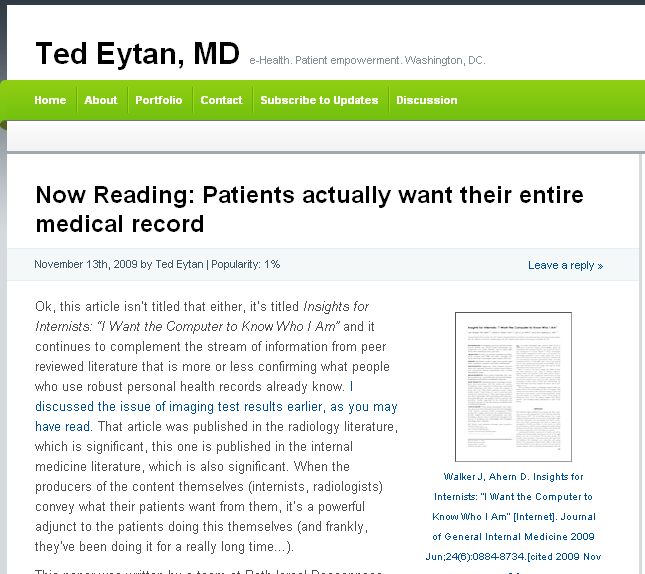
From Ted Eytan’s blog: “Now Reading: Patients actually want their entire medical record” | e

From Ted Eytan’s blog: “Now Reading: Patients actually want their entire medical record”

by e-Patient Dave on November 15, 2009

An important study just got my attention. Patients and clinicians in different cities were asked questions about concerns and preferences. Titled “Insights for Internists: ‘I Want the Computer to Know Who I Am’,” the study reports: (emphasis added)

  • Patients do keep their own medical records
  • They want access to everything in their record
  • Privacy worries “appeared to fade rapidly in the face of the desire to have records fully available in emergency settings and with multiple and new providers”
  • Click to read on Ted's blog

    “health professionals professed far more concern about maintaining privacy than patients.”

  • They understand that their clinicians are busy/stressed, they want the information to supplement and make their (clinicians) work more efficient, not less

Boy do I wish we’d all known about this during the debates about meaningful use and medical records this summer! There was so much talk about “Well what do people want?” and “Won’t patients be overwhelmed? They won’t be able to understand it.”

And here’s the thing: it was published back in May, and the research was done THREE YEARS AGO, Nov. 2006 to Jan. 2007.

How’s that for a great example of the “lethal lag time” we talk about in the e-patient white paper?  That’s the delay between when new knowledge comes into existence and when it’s made its way through the publication system, for use by decision-makers. Three years, in this case.

Thanks to the always magnificent, e-patient-minded Ted Eytan, MD for highlighting this study on his blog Friday.

Share and Enjoy:
  • Digg

  • del.icio.us

  • Facebook

  • Google

  • Reddit

  • SphereIt

  • StumbleUpon

  • YahooMyWeb

Comments

4 Responses to “From Ted Eytan’s blog: “Now Reading: Patients actually want their entire medical record””

  1. ICMCC Blog says:

    [...] The reason for this development is that there are few places that keep track of what is published in the field. A good example is the remark by e-patient Dave this Sunday: Boy do I wish we’d all known about this during the debates about meaningful use and medical records this summer! There was so much talk about “Well what do people want?” and “Won’t patients be overwhelmed? They won’t be able to understand it.” From Ted Eytan’s blog: “Now Reading: Patients actually want their entire medical record” [...]

  2. I’m stunned (in a good way) – as the above comment says, that article was posted on their site the same day.

    Here’s where you can subscribe to updates from their site.

  3. Aurelia says:

    Dave,

    I’m wondering if the same issues around privacy exist for controversial diagnoses. For example, psychiatric patients may not want their records to be made fully electronic, for good reason. To this day, discrimination exists even within the medical community against psychiatric patients who have physical illnesses. Which is why they tend to have higher rates of morbidity and mortality than others.

    It can literally kill you if a Doctor finds out you are on antidepressants.

    And employers? Automatically fire anyone with a psychiatric diagnosis. Child welfare authorities are more than happy to seize children from parents on a precautionary basis, with no evidence of harm. Even though patients who take their medication are better workers, and better parents.

    Same for women who have had abortions, or even prenatal diagnosis. In the old days, they would have been recorded correctly in paper files but only billed as D&Cs, which could be post-miscarriage D&Cs, to protect the lives of Doctors and the identity of patients. Pro-lifers have stated quite clearly that they will kill women. Do you think they can’t hire a hacker? I bet they can.

    I appreciate that security exists for people concerned about privacy, but the problem is that even one slip can destroy a life, or destroy a career. And the penalties so far are a joke. They need to be jailable offenses.

    A leg x-ray is not the same thing as a depression diagnosis.

    So I am quite happy to sit back and wait a nice long time for E-Records. I like staying alive.

  4. [...] e-patient info site by e-Patient Dave on November 16, 2009 In last weekend’s post about “patients want all their data” I said I wished I’d known about the article (published mid-May) during last summer’s [...]


Similar Posts

@TedEytan highlights an older study. Great info! Patients want to share - it might save our lives.

Posted via web from More pre-blogspot than pre-posterous

The PHR - will WebMDs walled garden win? I have my doubts

I read WebMD's whitepaper on the "The Integrated Personal Health Record and the Involved Consumer"

They seem to be recognizing the value of the engaged consumer. However it still seems like they are pushing their PHR as a walled garden. Ultimately I think the emerging ecosystem around the Untethered PHR - characterized by Microsoft HealthVault, Google Health and Dossia will win out. A walled garden is a nice concept but the open market provides richness and diversity that is difficult to compete against. This will be the challenge Apple faces in retaining iPhone Supremacy. It is the lesson AOL learned. WebMD may have a head start in terms of consumer trust and adoption but the vibrancy of the ecosystem we are seeing in the Health 2.0 space will win out.

Download now or preview on posterous
Untitled.pdf (154 KB)

Posted via email from More pre-blogspot than pre-posterous

Tuesday, November 10, 2009

#health2stat big crowd for tonights event

A series of 7 5minute presentations on the use of social media in healthcare.

Mark Scrimshire
B: http://ekive.blogspot.com
....Sent from my iPhone

Posted via email from More pre-blogspot than pre-posterous

Sunday, November 08, 2009

#hcnyc09 - The future of online communities

Real time commentary from HealthCampNYC

@Gfry Gilles Frydman of ACOR led the discussion on the future of online communities.

Is the objective to "make me better" or to "cure the disease" - These are two different objectives.

ACOR wants to work out how to de-identify data in their archives so they can open the data to the world. 

80% of people who find ACOR come from Google.

"The next generation of on-line communities should be built on schemas designed by the communities themselves."

"Social Structured Data Systems"

The current generation have been designed by specialists.

General discussion:

"While we wait for the revolution people are dying" We have to start change now - even if it only impacts a few people.

"If Health wants to make a difference then we have to move from using facts and figures to talking to the heart."

Posted via email from More pre-blogspot than pre-posterous

Saturday, November 07, 2009

#hcnyc09 - HealthCare Reform Progress & Outcome

Real Time Commentary from #HealthCareNYC

@boltyboy Matthew Holt providing commentary on The HealthCare Reform activity in Washington.

But this morphed into a discussion on the history and evolution of Health 2.0, Health 2.0 Accelerator and HealthCamp

There appears to have been another secret HealthCamp in Palo Alto, CA in May 2007. Does anyone have any information on that?

NCI, NCF, NIH, ARC and others have grants to offer.

How can the Accelerator leverage that?

Posted via email from More pre-blogspot than pre-posterous

#hcnyc09 - Do you want to know when you are going to die?

Real time commentary from HealthCampNYC

@jmbhan led a discussion on health screening.

How should we handle Health Screening?

Getting the patient in the door for a screening is personal responsibility.

Then the Doctor initiates the screening.

Stakeholders in the Screening:

- Patients/Consumers (should be educated enough)
- Employers
- Corporate Wellness

- Health Providers
- Doctors

- Payers

- Service Providers
- Labs (Like Quest, LabCorp)

How do we streamline the process. 

- Ordering and resulting tests.

A doctor with 3-4000 patients can't plan and execute all the screenings necessary.

Could we have an assisting process that enabled the patient to work out:

- What tests are available
- What tests are needed / recommended for the specific patient
- What is covered by their plan

- What about patient's who don't know what they have access to?

Can we create an app that uses Q&A via SMS text to guide people to the tests they should be taking.

Can we create a collaborative screening process that helps to decide what are the appropriate tests to have and evaluate the results.

Posted via email from More pre-blogspot than pre-posterous
#hcnyc09 - Health Care Law Blog: Visualizing HR 3962: Affordable Health Care for America Act

http://healthcarebloglaw.blogspot.com/2009/11/visualizing-hr-3962-affordable-health.html

Bob Coffield @bobcoffield has drawn up a great heat map of the Affordable Health Care Act.

Very topical for some discussions at HealthCampNYC.

Posted via web from More pre-blogspot than pre-posterous

#hcnyc09 - Health Care Law Blog: Visualizing HR 3962: Affordable Health Care for America Act

http://healthcarebloglaw.blogspot.com/2009/11/visualizing-hr-3962-affordable-health.html

Bob Coffield @bobcoffield has drawn up a great heat map of the Affordable Health Care Act.

Very topical for some discussions at HealthCampNYC.

Posted via web from More pre-blogspot than pre-posterous

#hcnyc09 @boltyboy Matthew Holt talking at healthcampNYC

Mark Scrimshire
B: http://ekive.blogspot.com
....Sent from my iPhone

Posted via email from More pre-blogspot than pre-posterous

#hcnyc09 @throopcat listening to @jmbhan

Mark Scrimshire
B: http://ekive.blogspot.com
....Sent from my iPhone

Posted via email from More pre-blogspot than pre-posterous

Friday, November 06, 2009

Cable Industry showing they are out of touch with the upcoming generation

http://news.slashdot.org/story/09/11/06/1639252/Cable-Exec-Suggests-Changing-Consumer-Behavior-Not-Business-Model?from=rss

The Article in Slashdot points to the Cable Industry losing touch with the upcoming generation of consumers.

Techdirt has pointed out yet another cable exec that just doesn't quite get it. Comcast's COO, Steve Burke, recently urged the TV industry to find ways to "get consumers to change" rather than figure out better methods to cater to demand."'An entire generation is growing up, if we don't figure out how to change that behavior so it respects copyright and subscription revenue on the part of distributors, we're going to wake up and see cord cutting.' How many consumers, in any market, are focused on 'respecting' vendors' revenue streams? How, exactly, does he propose to effect this sea change? And why not just develop products that consumers will willingly pay for, rather than trying to change consumer behavior in such a fundamental way?"
The democratization of content and information is changing the playing field. The answer isn't to attempt mass indoctrination. Instead the cable and other industries (I include the Health Care Industry in this group) have to wake up and work out how they can clearly demonstrate the value they provide.  Stop building walls to keep me in or out and instead put effort in to creating real value that I want to pay for.

Posted via email from More pre-blogspot than pre-posterous

Apple's App Store hits 100,000, displays ultimate irony - Computerworld Blogs

Apple's iPhone App Store, as long expected, passed the 100,000 app mark today.  Apple has been counting down the milestones since the store opened, last mentioning 85,000 in a conference call last month.  There are some interesting trends developing, however, that put that number into perspective.

First of all, most apps aren't the wild successes that you've heard stories about.  In fact, according to a recent study, if you are not in the top 1000 (or 1%) apps, you aren't going to be installed on more than 1.67% of iPhones and iPods. That same study said that only 20% of all apps ever get more than a few downloads.

Another recent phenomenon has been running up the App Store count.   Books are turning into Apps.  This isn't like the Kindle App which can read many books in the one reader app or purchase books in-app.  Companies like Scrollmotion have engines that turn a lot of recent book releases into seperate, individual apps with little effort.

It isn't just first run books, however.  Companies are taking books in the open domain and building apps around them.  There are probably 10 $.99 War and Peace apps in the store.  

Same goes for most classics. How about Sun Tzu's Art of War? Over 30 apps for one book title.

This free book to cheap app model probably accounts for thousands of "apps".

Finally, all of this belies the ultimate irony for Apple.  For decades, they've been struggling with their Mac platform because most app(lication)s are written for PC first.  Then, sometimes they are written for Mac, sometimes they aren't (and they are also crippled like Microsoft Office).  This has traditionally been the major barrier to entry for prospective Mac customers who've gone to Windows. 

Apple would try to convince people that it wsn't the quanity of applications but the quality, and that native Mac Applications were better.

Over the past five years, the Web and a host of other factors have tempered that trend, but it still exists -especially in the corporate world. 

Now,  Apple is king of the apps in the smartphone realm and spouts their total at every opportunity.  Perhaps they are making up for years of app-envy?

So there are 100,000 apps in the App Store. According to AppShopper (http://Appshopper.com) there are 106,794 apps approved but only 97,435 actually available in the Apps Store.

I don't browse around the App Store much. Instead I tend to listen to the Apps that are being suggested by friends on Twitter. I did take a quick look today and came away wondering if there was an App to count the number of Apps in the App Store?

Posted via web from More pre-blogspot than pre-posterous

Thursday, November 05, 2009

#hcnyc Countdown to HealthCampNYC - 1 day to go!

Once again HealthCamp hits the big apple! Last year HealthCamp took place under the umbrella of the Web 2.0 Expo in the un-conference track. This year, thanks to the the tireless efforts of Eugene Borukhovich (@healthEugene) HealthCampNYC (#hcnyc) stands on its own. Saturday morning at 8:30 sees HealthCampNYc kick off at the Teacher's college in Columbia.
We have worked out an arrangement with the college to allow last minute participants to join in. So head over to http://healthcampnyc.eventbrite.com and grab a ticket and join in.
If you can't make the event in person please check out the Twitter Stream. The CoverItLive feed should be available (See Below) or over on the HealthCa.mp network's wiki at http://bit.ly/hcnyc_w. The CoverItLive feed is on the Discussion page.


Okay, I am off to pack ready for the trip up on Friday. If you make it to HealthCampNYC come and say hello. If you can't make the event but will be near Washington DC on Tuesday December 1st then you could come along to the #SecretDCHealthCamp  ....whoops. I was supposed to be keeping that a secret. So please, don't tell anyone you don't know!

Social Learning Camp

Social Learning Camp has a fascinating Pin Board from PinDax. (http://www.pindax.com/showSubscribe.asp?bid=3866)

Posted via web from More pre-blogspot than pre-posterous

Wednesday, November 04, 2009

10 Things to Hate About the iPhone - IT Management

This seems to be dredging the bottom of the barrel for 10 reasons. In an enterprise oriented magazine that is trying to justify why the iPhone is not right for business they highlight a gardening app as an example of "So-So" apps.
The fact is that the browser still runs rings around the Blackberry when presenting web content.

Posted via web from More pre-blogspot than pre-posterous

Tuesday, November 03, 2009

Open Mobile Health Exchange: A Microsyntax.org Project - /Message

« links for 2009-11-03 | Main

November 03, 2009

Open Mobile Health Exchange: A Microsyntax.org Project

I am happy to announce that Alan Viars will be heading up a new project for Microsyntax.org, called Open Mobile Health Exchange:

via www.microsyntax.org

OMHE (Open Mobile Health Exchange), pronounced “ooommm” is an open-source microsyntax for medical devices, and other “short text capable” systems. OMHE is used for sending blood pressure, blood glucose, weight, step-per-day, pain levels, and other common information often sent between people and their health care provider. It’s designed to be easily typed on a mobile phone, while at the same time, easy for machines (i.e. computer, applications) to understand. Although OMHE is simple enough for manual human entry, its not always necessarily typed directly by humans. For example, many applications may present the user (human) with a graphical user interface (GUI), but still use OMHE as the underlying data format. OMHE can also be used for “machine-to-machine” communication. For example, OMHE is an output message format suited for medical devices such as pedometers, blood glucose meters, and blood pressure meters, weight scales, and other hardware.

I think OMHE is a good indicator of how machines in the future will be communicating with us, and each other, via microsyntax.

For more information, please refer to the OHME project.

TrackBack

Comments

Feed

You can follow this conversation by subscribing to the comment feed for this post.

Verify your Comment

Previewing your Comment

Posted by:  | 

This is only a preview. Your comment has not yet been posted.

Your comment could not be posted. Error type:
Your comment has been saved. Comments are moderated and will not appear until approved by the author. Post another comment

The letters and numbers you entered did not match the image. Please try again.

As a final step before posting your comment, enter the letters and numbers you see in the image below. This prevents automated programs from posting comments.

Having trouble reading this image? View an alternate.

For those of you at HealthCampMd in June you will remember that Alan Viars announced OMHE as one of our Lightning Talks. It is great to see this project being picked up under Stowe's Microsyntax initiative.

Posted via web from More pre-blogspot than pre-posterous

Monday, November 02, 2009

HealthCamp on Blog Talk Radio On November 3rd at 12pm EDT

HealthCamp  

HealthCamp is an "un-conference" event with interest in the transformational potential afforded by emerging Social Networks, Open Standards and the latest web and mobile technologies to facilitate needed change in the healthcare financing and delivery space. The HealthCamp series is a growing, grassroots phenomenon, emerging from the ad hoc gathering known as "Barcamp". Events are being held, or planned, across the country as well as internationally, as part of the "Health 2.0" movement towards participatory (i.e, consumer driven) healthcare - where patients, members or consumers, take an active and informed role in their care in conjunction with their physician, hospital, ancillary or allied health practitioner, etc.

  • Upcoming Episodes

    Date / Time: 11/3/2009 12:00 PM

    Category: Health

    Call-in Number: (718) 506-1723

    www.blogtalkradio.com%2fHealthCamp%2f2009%2f11%2f03%2fHealthCamp--Whats-It-All-About" class="FT" rel="nofollow" target="_blank">

    Join Mark Scrimshire, aka @ekivemark, and Gregg Masters, aka @2healthguru, for a conversation on the emerging 'HealthCamp phenom', and plans underway for un-conferences scheduled in the US and beyond. HealthCamp is about putting social media, open source and the best of the Internet, Mobile web and process innovation to work for better health care and health technology. HealthCamp is a user-organized "un--conference" movement that brings consumers, health providers, health industry experts and technology professionals together for a one day event to exchange ideas informally, locally, openly. Participants themselves provide the content, with break-out sessions they develop themselves and plug into a schedule grid on the day of the event. Anyone can present and host a session in nearly any format. For more information: http://www.socialtext.net/healthcamp/index.cgi?healthca_mp

Tomorrow I am chatting with Gregg Masters on HealthCamp Radio on the BlogTalk Radio network. We will be talking about the HealthCamp Phenomenon in the run up to HealthCampNYC this Saturday (11/07), SecretDCHealthCamp on December 1st and HealthCampSanDiego which is being planned for January/February 2010.

Take 30 minutes and listen in!

If you can't make it you can go to http://healthcampnyc.eventbrite.com to sign up for this weekend's HealthCamp in New York City.

Posted via web from More pre-blogspot than pre-posterous